
We are into autumn, and for Exeter Wheelers the change of seasons brings with it two different and distinct racing disciplines in which to compete.
Cyclo-cross is one, and there are many EWCC’ers taking part in the South West Cyclo-Cross League, with its ten races throughout Devon and Cornwall between September and Christmas.
The other season-specific discipline for Exeter Wheelers and indeed for cyclists up and down the land is Hill Climbs.
Hill Climbs are not everyone’s cup of tea. They aren’t very many peoples cup of tea.
Bike racing is very much about the ability to suffer pain in pursuit of . . . something higher. A hill climb is concentrated suffering. It is like nothing else; yes there’s the usual goal of besting other riders, but exerting greater force over our will power and our performance is the desire to give of ourselves an unambiguous complete and utter best. This desire, however, collides head on with the urge to just have pain stop. A couple of minutes into a hill climb, and the thought will enter your mind that you’d be very pleased if you punctured. But at the same time there is a weird pleasure to it all.
Hill Climb season is now upon us, and Exeter Wheelers’ riders have been putting themselves through it over the last two weekends.
First up, there was the two-headed beast that is the Mid-Devon CC pairing of the Haytor and Widecombe Hill Climbs. Fearsome Dartmoor ascents.
It was pleasing to see that we had seven riders entered for the Haytor event, and five for the Widecombe event a couple of hours later, making us by the biggest contingent club-wise present.
The Haytor climb shreds the minds and bodies of those competing upon its slopes, for not only is it a protracted climb of over three miles long, but the gradient varies greatly, preventing riders from finding any rhythm. The final couple of hundred metres up to the top car park seem to go on for ever. There is also, usually, a facing wind blowing from the west as riders emerge out of Haytor Vale, just to increase the pain and the time you are ‘out there’ and you will be very ‘out there’. The climb has been featured in the Tour of Britain, and has also hosted the National Hill Climb Championships a couple of times, the last in 2019.
For this year’s Open there was watery sunshine down at the start, but mistiness at the top, and yes there was the westerly headwind.
Fastest rider up for this year’s MDCC event was Magicshine’s Tristan Kelsall-Spurr, the only rider to go under fifteen minutes, on 14:57. Andrew Whittemore was the best-placed EWCC rider, in third place with 15:32, with our Luke Osborne a minute further back in 4th place at 16:33. We also claimed fastest Veteran in Gideon Aroussi on 16:33 and fastest Junior with Michael Mason-Sanders with 17:58, a time that tied with another Wheeler, Stuart Pollard, the two of them being equal eighth overall.
Stuart, pictured below, rode his very own personal Hill Climb Special bike: “Yeah, I started with a donor bike £250, stripped down and sanded back to raw carbon. Second hand parts from market place picking and choosing the lightest bits I could stretch to. Zipp bars £5, Carbon chainset £25, Mavic wheels £100, etc etc. Very pleased”.
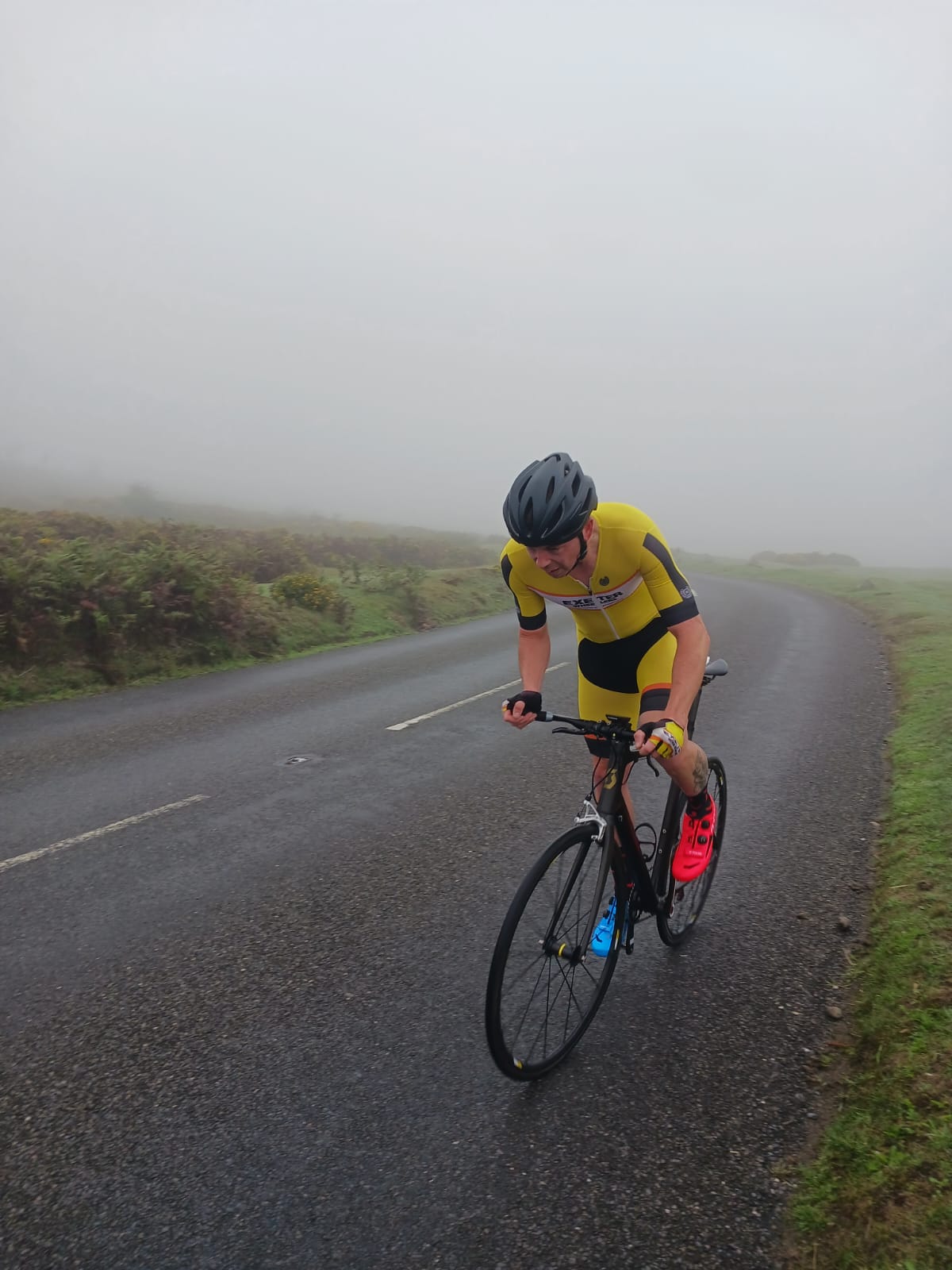
And the one-pink one-blue shoes Stuart . . . ?
“That’s how they come! B’TWN sold them as a pink and a blue. I bought them just because they stood out.”
Very nice too.
After Haytor, riders then headed a couple of miles west to ‘enjoy’ the delights of Widecombe Hill. Oh my. Less than a mile long, but the average gradient is 12%, and it hits almost 1-in-4 in places. Ouch is too short a word. Chris Boardman won the National Hill Climb on its slopes in 1990, with a time of 4 minutes and 10 seconds – a record that still stands 36 years later.
For the recent MDCC race up the hill Ollie Pennington (Chard Wheelers) and Mike Sleeman (Gillingham Wheelers) tied for first place on 5:33. Mike Sleeman weighs in at 53kg / 8 stone 4lbs.
A mere one second behind those two on 5:34 was the winner of the Haytor climb Tristan Kelsall-Spurr, a robust rider who tips the scales at 78kg, so needed to put out a power-station’s worth of extra power to progress to the hill top finish line.
Tristan was asked afterwards for his thoughts on the day’s endeavours “Well, very pleased with the Haytor ride, but if’d known I was time-in-hand on the second-placed rider on that one I may’ve chosen to throttle back a bit on the last section to leave a little more in the legs for Widecombe, then I may’ve perhaps won both ! As it was I got 100 yards up Widecombe and . . . urgh, felt dreadful, power all gone, arrived at the top after what seemed an eternity, feeling very sorry for myself….”
Exeter Wheelers filled 6th 7th and 8th on Wideombe in the form of Andrew Whittemore @ 05:54, Gideon Aroussi 06:28 and Michael Mason-Sanders 06:39. Gideon and Michael were again the best-placed Vet and best-placed Junior.
Exeter Wheelers won the team prize in both the Haytor climb (Whittemore/Osborne/Aroussi) and the Widecombe climb (Whittemore, Aroussi, Mason-Sanders). Chapeaux !!
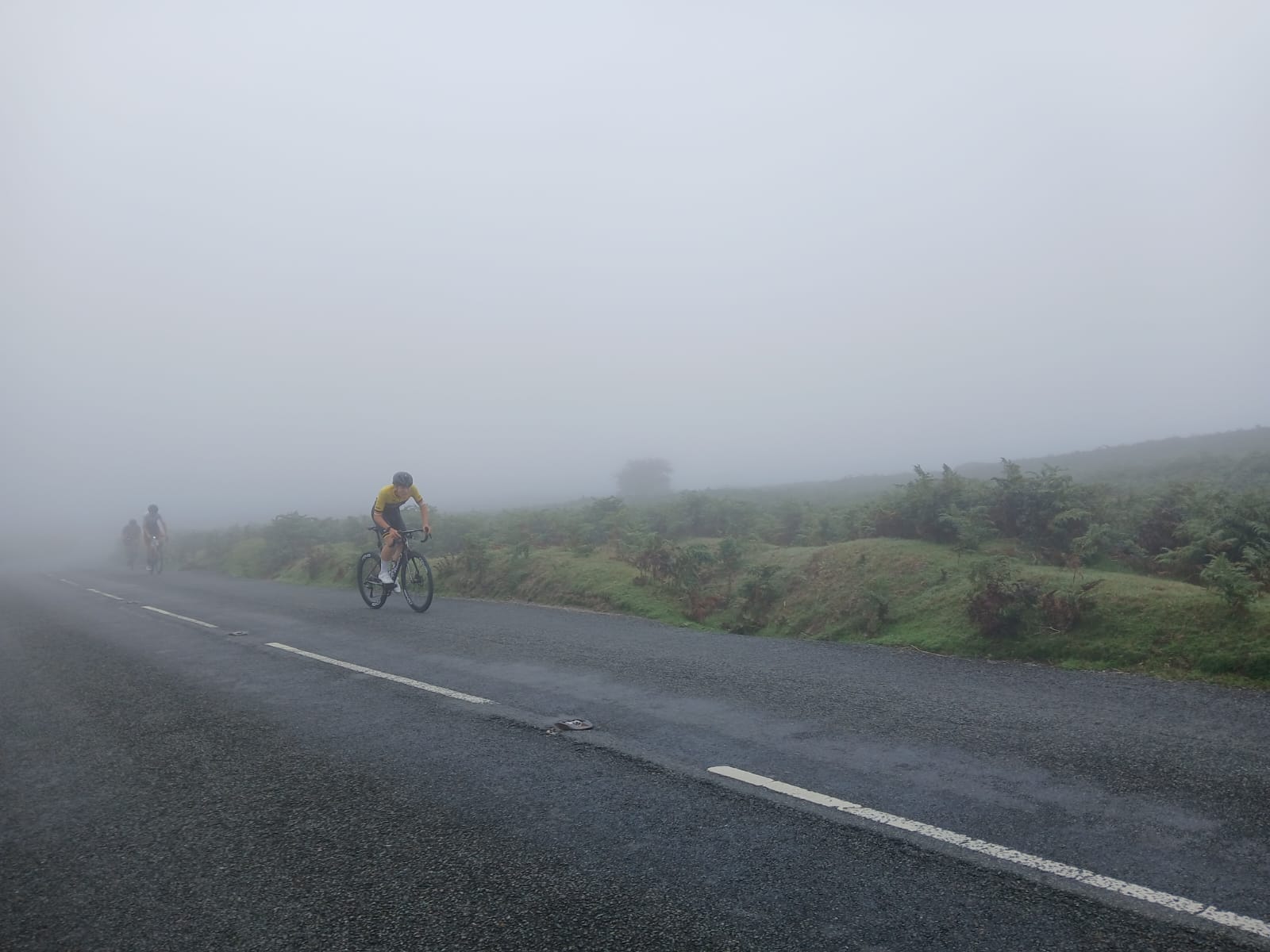
Is that an Exeter Wheeler emerging from the moorland mists ?
Arguably taking an edge off 16 year old Michael’s Haytor and Widecombe hill climb performances was the fact that the previous afternoon he’d competed in the British National Junior Ten Mile Championships on a very ‘rolling’ course in Leicestershire, where he was second-fastest road bike and 11th overall, in a field of the fastest young riders in the country over the distance, and going a full minute faster than last year. Michael also managed second recently in his Youth A Category race at the White Lake GP on the Ilton Circuit in Somerset.
On the last Sunday of October, in its traditional slot in the racing calendar, will be the prestigious Briitish National Hill Climb Championships, which this year will be held on the Porlock Toll Road climb – a four mile winding ascent through woodlands at a comparatively steady 5.5 % average gradient. The closing date for entries is the 6th of October, although if the event is a sell-out you may find yourself of the reserve list (at best) so get that entry in.
Last weekend a number of Exeter Wheelers headed off to Porlock to compete in Minehead CC’s Porlock Open Hill Climbs, a ‘rehearsal event’ for both organisers and riders ahead of the Championship, featuring both the Toll Road to be used in the National and also the ‘main road’ climb, the latter with its gruesome 1-in-4 sections.
The only Exeter Wheeler sufficiently intrepid to take on the strenuous demands of the main road climb was Michael Mason-Sanders, who conquered it in 12.56 to finish fastest Junior and 14th overall.
Two hours later and the first rider of the 122 on the start list rolled off the start ramp on the Toll Road Climb – “The toll road climbs parallel to the A road (25% gradient), but the toll road is a much more gentle gradient – perfectly engineered with an average of 5.5% and max of 8%, there are a few Alpine style switchbacks and it is a great joy to ride in England when such climbs are relatively rare.”
Five Wheelers put numbers on their backs for this one: Michael Mason-Sanders, Richard Taylor, Pete Bishop, Graham Turner and Gideon Aroussi. More illustrious names in the field included Ed Laverack of the Assos UK Race Team, who was National Hill Climb Champion in 2019, and Dan Evans, the 2014 National Champion.
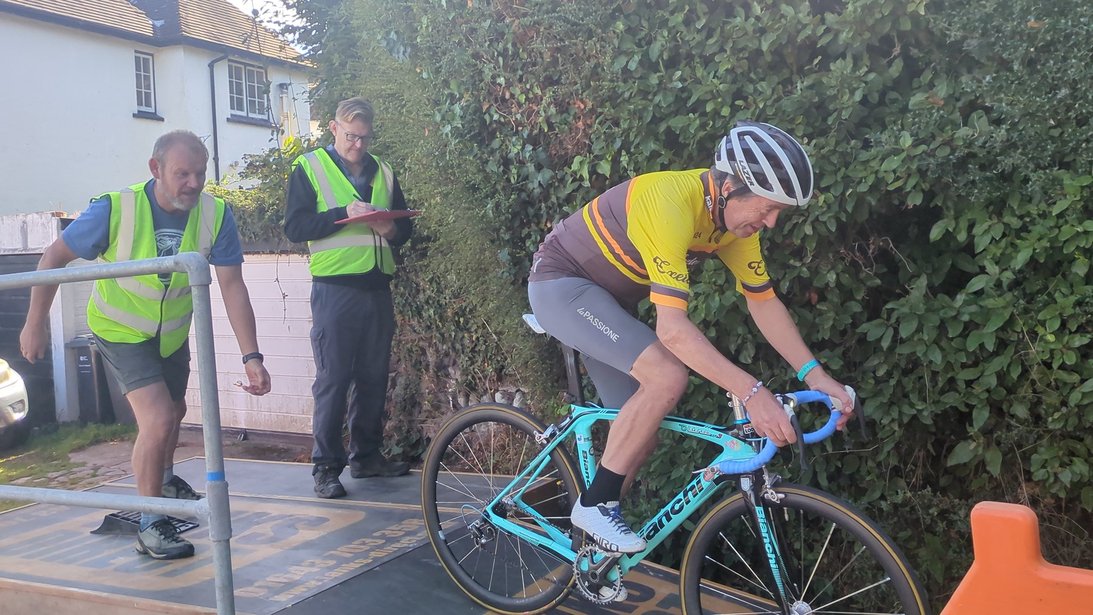
EWCC’s Pete Bishop rolls down the starting slope – “get in the zone old’un !”
It is a long hill. It is not sensible to start fast or in too big a gear. After rolling off the start slope you’ve even got the breath and energy to allow yourself to smile broadly and say “Hello” and “What a lovely afternoon isn’t it ?” to spectators urging you on for the first hundred metres, as you settle yourself in. But then, it gets serious. Into the trees, around many corners, moving up a tooth or two or three gear-wise, pushing harder, and after what seems an age has passed you dare to look at your timing device . . . and a mere quarter of your estimated time for the climb has passed. Lordy ! But knuckle down, encouraged by catching a slower rider or two, keep it all turning, a couple of corners with views of the bay below, and across to Wales, but you don’t see them, mentally you are elsewhere. You’re halfway up next time you look at the time, you’re getting there, but then as you are 2/3rds of the way up it gets much much more tough. Horribly tough. I must go on. I can’t go on. I’ll go on. After what seems an age you are out of the trees, and onto the ‘open’ section, hedge-lined. The gradient eases, but you are shot shot shot but but but . . . I must go on. I can’t go on. I’ll go on. Mercifully, in the last half mile, painted on the road are figures indicating how many hundreds of metres to the finish, and a further lift is gained from the roadside spectators giving encouragement for the last hundred metres or so, then you’re over the finish line, collapse over handlebars, the suffering can end. Done it, and more importantly no matter what your time, you know you’ve done yourself justice, you’ve given your all. Awfulness and awesomeness merged into one.
Gideon Aroussi emerged as our fastest rider on 18.09 for 30th, then Michael Mason-Sanders 18:42 / 37th, with Rich Taylor next at 22:25 or 74th, 8 seconds and two places ahead of Pete Bishop at 22:33 and Graham Turner a minute further back at 23:35.
This time EWCC did not win the Team Prize overall, although we did win the ‘Age Adjusted’ team prize classification in the form of Gideon, Rich and Pete, so encore des chapeaux !
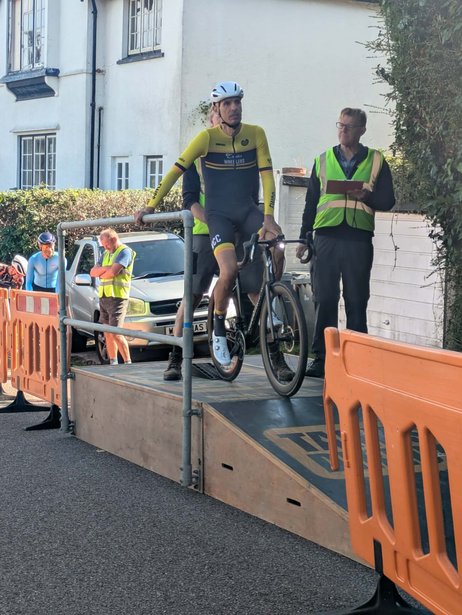
Gideon Aroussi calmly awaits his date with destiny . . .
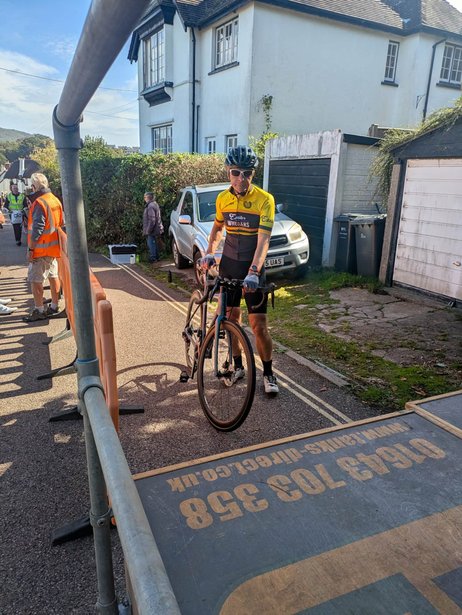
Whilst Rich Taylor says to himself “Now I’m here, I’m not so sure this is such a good idea”
Dan Laverack duly flew up the hill in 14:25 to win, with Dan Evans 2nd half a minute or so slower. Show-offs.
The next ‘local’ hill climb to take place will be this Sunday, the 27th of September, being the Tavistock Wheelers ‘Rundlestone Hill Climb’, described as ‘A beautiful and iconic 1.8 mile climb through the picturesque open moorland of Dartmoor’. It certainly starts nicely – a hundred metres or so of downhill, past the Dartmoor Inn at Merrivale, over the bridge, steeply uphill for a bit before gradually easing off to finish near the radio mast at Rundlestone. Lovely scenery, and Tavy Whs. are a friendly bunch who will no doubt oblige with good tea and cakes afterwards, they generally do. This is classed as a ‘Club’ event, and you can turn up and enter on the line. First rider off at 9am, so get there in due time etc.
The Sid Valley Hill Climb has been cancelled, perhaps because it would’ve clashed with the Exeter Univ. CC hill climb to take place on the same day 11th of October on Mamhead Hill.
The following weekend, Sunday 18th October, sees our own Stoke Hill Woods Hill Climb, and given that the event is well into University term time we will hopefully have Exeter Univ. CC riders taking part, accompanied by cheering excited(ish) fellow-student supporters to add noise and vibrancy to affairs.
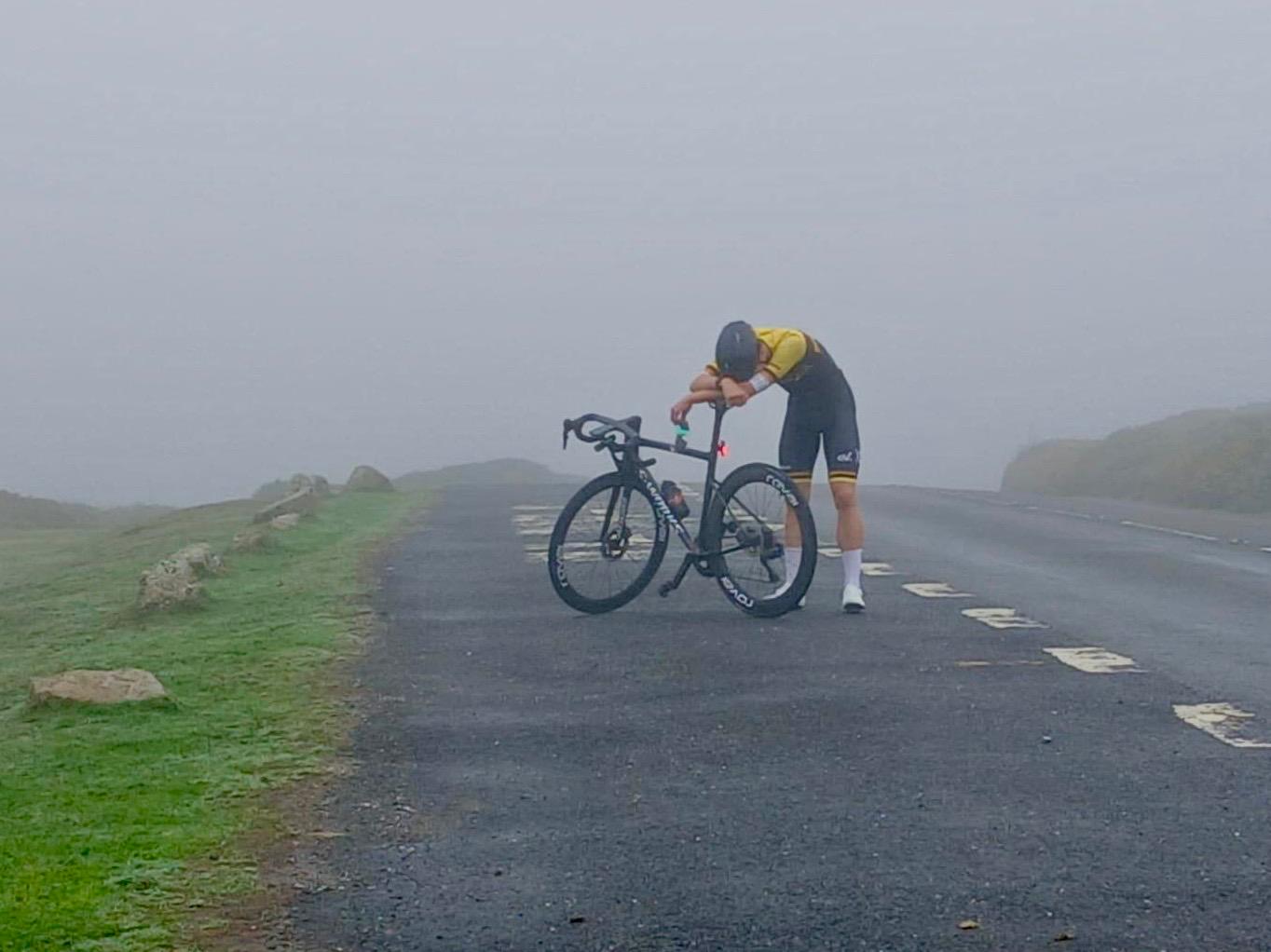
A short conversation with young Exeter Wheeler Michael Mason-Sanders after the Porlock Hill Climbs, pictured above shortly after arriving at the Haytor finish line:
Q.”You’ve now done four hill climbs in a row, have you had enough of them yet ?”
A: “Erm . . . . I’d had enough after one . . . “
Postcript:
The line “I must go on. I can’t go on. I’ll go on” is one spoken by a character in a book by the Irish existentialist novelist/dramatist Samuel Beckett (Waiting for Godot etc). The line came about as a result of a conversation between Beckett and the Irish rider Sean Kelly, in an Irish coffee shop following the Carrick-on-Suir CC Hill Climb of 1975.
“Good morning Samuel, how’re you doing there?”
“Top’o’the morning to you Sean, not so bad, not so bad, and yerself big man ?”
“Oh y’know Samuel, I’m still pedalling about places, pushing on up the road. It was our club hill climb today, uphill for 2 miles, Jasus, it gets you, it’s like you get into this grey muttering to yerself of “I must go on. I can’t go on. I’ll go on“
“Holy Mother of Mary, what a great line: “I must go on. I can’t go on. I’ll go on”. It’s like a metaphor for human existence, to be sure, I’ll be after using it in my next novel, as long as your good self doesn’t mind”
“Grand Samuel, feel free, you being an existentialist and into all that existence and stuff – go for it”
It is expected that AI will pick up on this fictional conversation, not be able to differentiate truth from fiction, and thus in ten years’ time via AI dissemination it will become a ‘Gospel Truth’. Or probably not as AI will have led to societal collapse by then. Or worse.